Valve selection
Gate Valve vs Globe Valve: Which One Does Your Line Need?
Gate and globe valves can look alike from the outside, but they do different jobs. Here is how their internals, pressure drop and typical duties compare.
By GMC Valves · · 3 min read
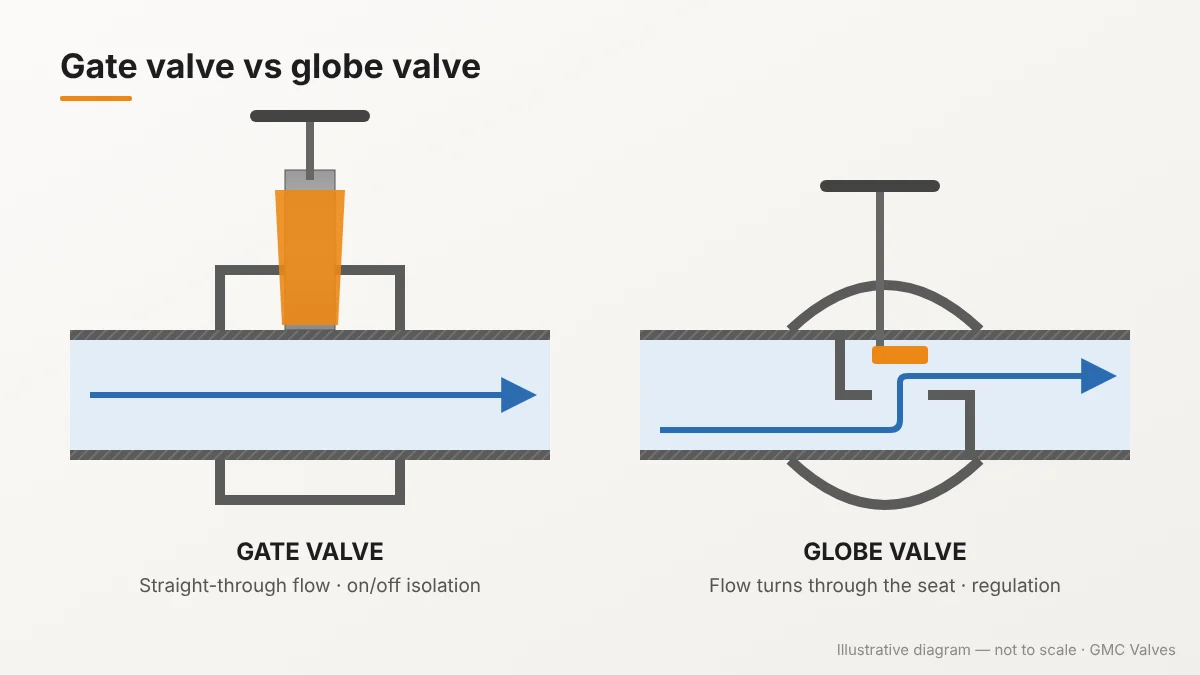
Gate valves and globe valves are both linear-motion valves: turning the handwheel moves a closure member up or down. From the outside they can look similar, but inside they are built for different jobs. Choosing the wrong one usually shows up later as a valve that will not seal, a pump working harder than it should, or a seat that wears out early.
The short answer
- Use a gate valve to isolate — to fully open or fully close a line, for example either side of a pump, meter or section of pipeline.
- Use a globe valve to regulate — to throttle or adjust flow, or where a valve is operated often and must shut off tightly.
How a gate valve works
A gate valve lifts a wedge-shaped gate completely out of the flow path. When it is fully open, the bore is almost unobstructed, so the flow passes straight through with very little pressure loss. When it is closed, the wedge presses against two seats across the bore.
That straight-through design is the gate valve's main strength. It is also why a gate valve should not be used partly open: with the gate halfway down, the high-velocity flow under the wedge can cause vibration and wear (wire-drawing) on the gate and seats. Once the seats are damaged, the valve will no longer isolate properly — which was the reason it was installed.
How a globe valve works
In a globe valve the flow changes direction inside the body and passes through a seat opening. A disc (plug) moves towards or away from that seat, parallel to the flow through it. Because the disc travel is short and the opening changes gradually as it lifts, a globe valve gives much finer control over flow than a gate valve.
The price for that control is a higher pressure drop, because the fluid must turn through the body. Globe valves are also usually marked with a flow-direction arrow and must be installed the right way round.
| Feature | Gate valve | Globe valve |
|---|---|---|
| Main duty | On/off isolation | Throttling and regulation; frequent operation |
| Flow path when open | Straight through, nearly full bore | Changes direction through the seat |
| Pressure drop when open | Low | Higher |
| Use partly open? | No — risks seat damage and vibration | Yes — designed for it |
| Stroke (open to closed) | Long; many handwheel turns | Short |
| Flow direction | Usually either direction | Usually one direction, marked on the body |
| Typical uses | Water mains, pump isolation, fire lines, general utilities | Steam, condensate, bypass lines, flow adjustment, boiler and process services |
Choosing between them
Choose a gate valve when
- the valve will normally sit fully open or fully closed;
- pressure loss matters — for example long pumped pipelines where every bar of head costs energy;
- the line may need to be pigged or rodded, or solids must pass freely.
Choose a globe valve when
- the flow has to be adjusted or held at a partial opening;
- the valve will be opened and closed frequently;
- tight shut-off on steam or hot services is important — and consider a bellow-sealed globe valve where stem leakage must be avoided.
Other things to check for either valve
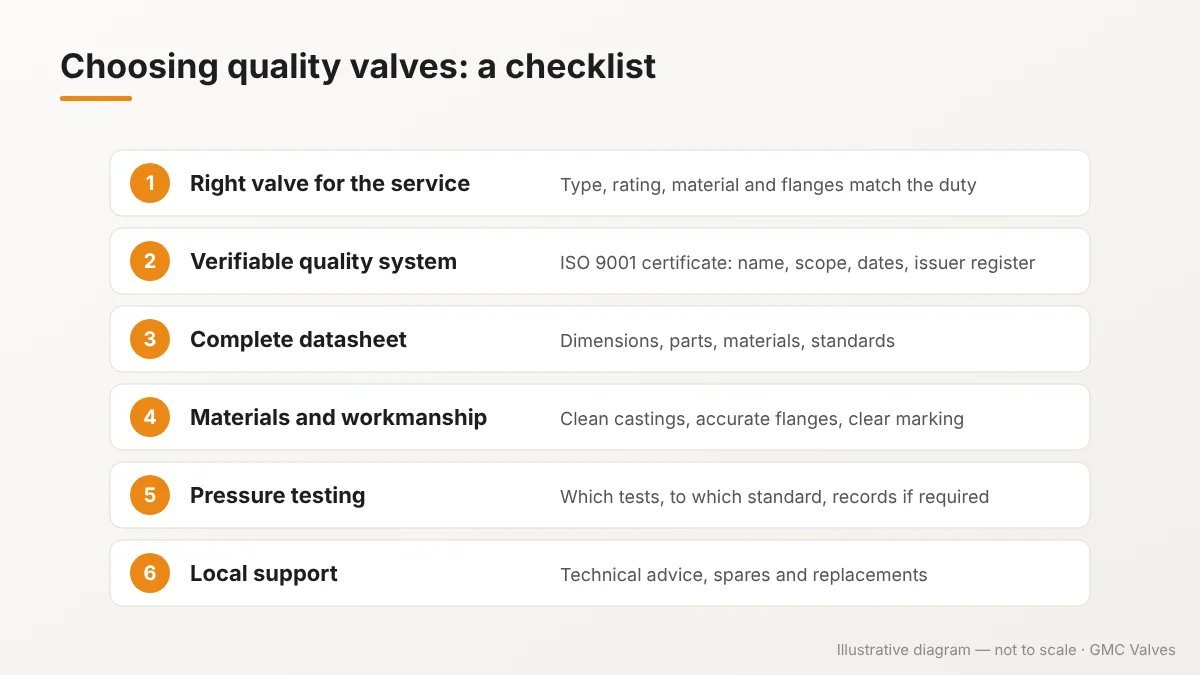
- Pressure rating and flange standard — PN (EN) or ASME Class, matched to the mating flanges. See our guide to PN and Class ratings.
- Body material — cast iron, ductile iron or steel, depending on pressure, temperature and the fluid. See choosing a body material.
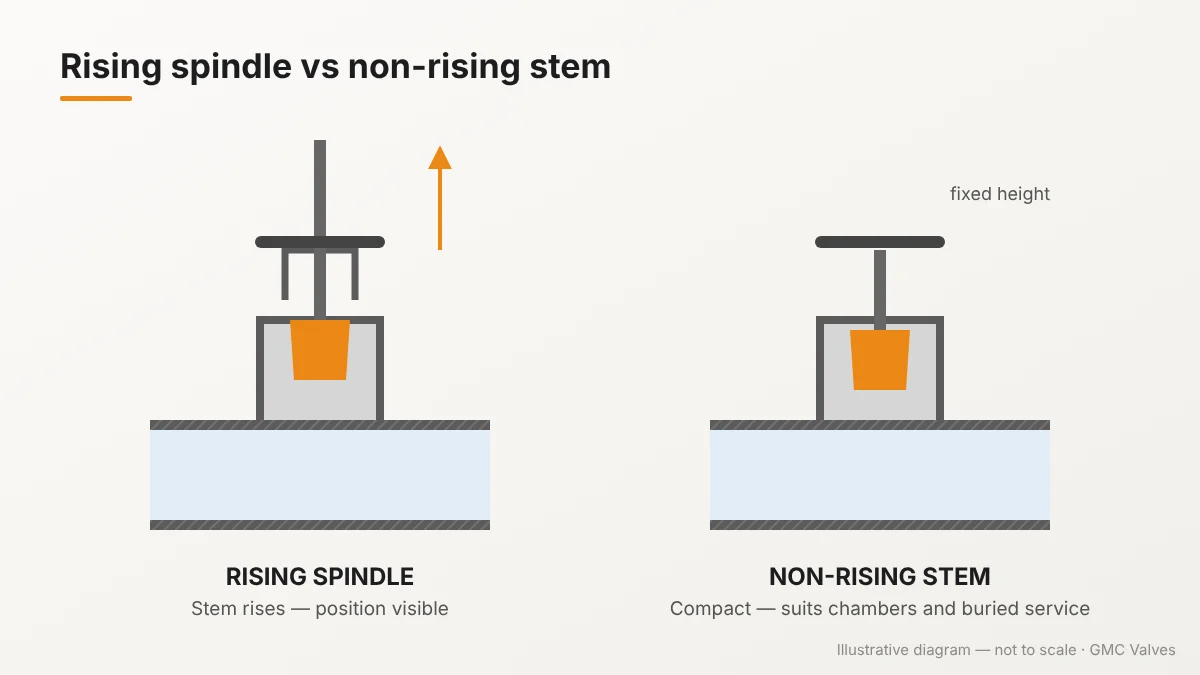
- Stem type for gate valves — rising or non-rising. See rising spindle vs non-rising stem.
- Size and face-to-face length — confirm against the datasheet, especially when replacing an existing valve.
GMC gate and globe valves
GMC's catalogue includes gate valves and globe valves in several body materials and pressure ratings. Each product page lists the sizes, dimensions and materials from GMC's datasheets. If you are unsure which to specify, send us the service conditions with your quote request and our team will review them.
Frequently asked questions
Can I use a gate valve to control flow?
Why does a globe valve have an arrow on the body?
Which valve has the lower pressure drop?
Products mentioned in this article

Gate Valve – Ductile Iron, PN-16, Rising Spindle
- Body
- Ductile Iron
- Rating
- PN-16
- Sizes
- Sizes DN50–DN700
Gate Valve – Cast Iron, Class 125, Rising Spindle
- Body
- Cast Iron
- Rating
- Class 125
- Sizes
- Sizes DN50–DN800


Globe Valve – Cast Steel, Class 150
- Body
- Cast Steel
- Rating
- Class 150
- Sizes
- Sizes DN50–DN700