Valve selection
Swing, Lift or Wafer? How to Choose a Non-Return (Check) Valve
A non-return valve stops reverse flow automatically. The right type depends on pressure drop, space, orientation and how quickly flow reverses when a pump stops.
By GMC Valves · · 2 min read

A non-return valve — also called a check valve — lets fluid flow one way and closes automatically when the flow tries to reverse. It needs no operator, so it is easy to forget about. But a poorly chosen check valve can cause slamming, water hammer or wasted pumping energy. GMC's catalogue includes swing, lift and wafer types; here is how they differ.
Swing check valves
A swing check valve has a hinged disc. Forward flow pushes the disc open; when flow stops, the disc swings back onto the seat under its own weight and the reverse flow.
- Low pressure drop when fully open, because the flow passes fairly straight through.
- Relatively slow to close because the disc travels through a large arc. In systems where flow reverses quickly — for example, a pump stopping on a high-head rising main — that delay can let reverse flow build up, and the disc may then slam shut.
- Orientation: normally horizontal lines, or vertical lines with upward flow. Confirm with the datasheet or manufacturer.
Lift check valves
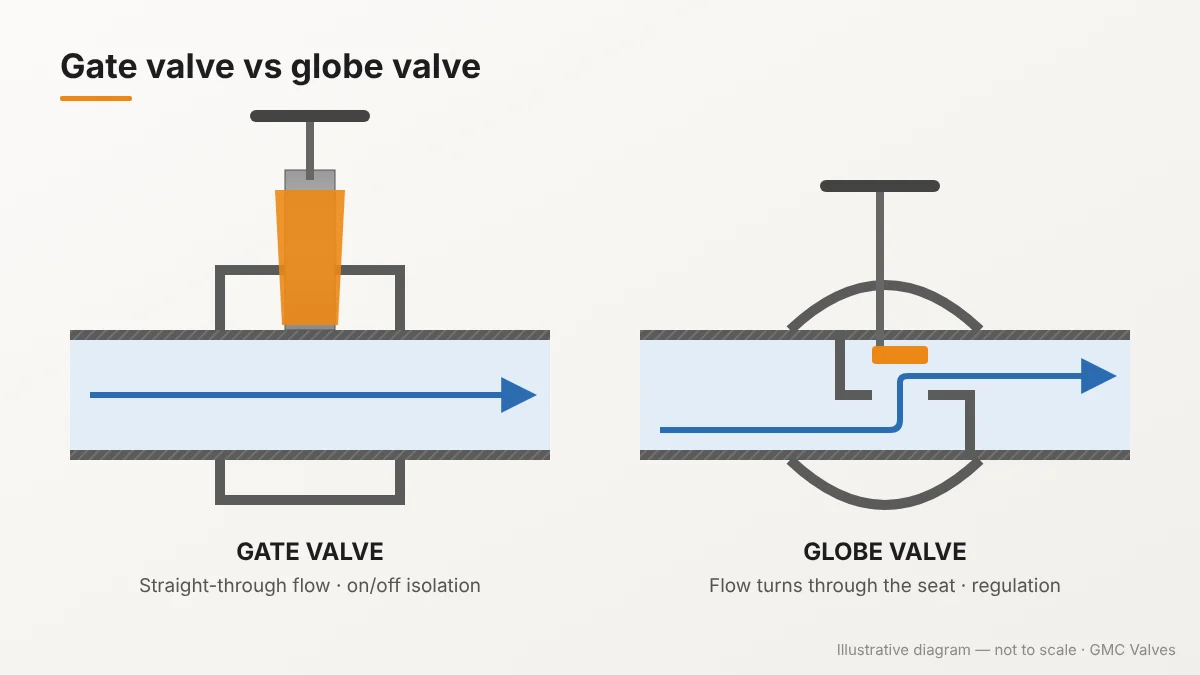
A lift check valve has a body similar to a globe valve. The disc lifts vertically off the seat with forward flow and drops back when flow stops.
- Short travel, so it closes quickly and seals well.
- Higher pressure drop, because the flow turns through the body.
- Common uses: steam, condensate, compressed air and smaller water lines, and services with frequent flow changes.
- Orientation: horizontal-line designs must be installed with the disc guide vertical. Check which orientation the valve is designed for.
Wafer check valves
Wafer check valves are thin bodies clamped between two pipe flanges. Dual-plate designs use two spring-loaded half-discs that close quickly.
- Compact and light — useful where space or weight is limited.
- Fast, spring-assisted closing helps reduce slam in pumped systems.
- Check clearances: the plates open into the pipe, so make sure adjacent valves or fittings do not obstruct them, and confirm the flange standard because the bolts pass around the body.
| Type | Pressure drop | Closing speed | Size / weight | Good for |
|---|---|---|---|---|
| Swing | Low | Slower | Large | Low-head water, general utilities, horizontal lines |
| Lift | Higher | Fast | Medium | Steam, condensate, smaller lines, frequent cycling |
| Wafer (dual plate) | Low to moderate | Fast (spring assisted) | Compact | Pump discharge, tight spaces |
Reducing slam and water hammer
- On pump discharges with high head or long rising mains, prefer a valve that closes quickly, before significant reverse flow develops.
- Avoid installing a check valve directly after a pump outlet, elbow or reducer where turbulent flow can make the disc flutter. A straight run of several pipe diameters upstream is a common rule of thumb; follow the manufacturer's advice.
- Size the valve for the actual flow, not just the pipe size. An oversized check valve may never open fully, so the disc chatters and wears.
- For severe surge, a surge analysis may be needed — the check valve is only one part of the solution.
GMC non-return valves
GMC's non-return valve range includes swing type, lift type and wafer type valves in several materials and ratings. Add two or three to the comparison to see their dimensions together.
Frequently asked questions
What is the difference between a check valve and a non-return valve?
Why does my check valve slam when the pump stops?
Can a swing check valve be installed vertically?
Products mentioned in this article

Non-Return Valve – Ductile Iron, PN-16, Swing Type
- Body
- Ductile Iron
- Rating
- PN-16
- Sizes
- Sizes DN50–DN700

Non-Return Valve – Cast Iron, PN-16, Lift Type
- Body
- Cast Iron
- Rating
- PN-16
- Sizes
- Sizes DN50–DN300

Non-Return Valve – Ductile Iron, PN-16, Wafer Type
- Body
- Ductile Iron
- Rating
- PN-16
- Sizes
- Sizes DN50–DN600

Non-Return Valve – Cast Steel, Class 150, Swing Type
- Body
- Cast Steel
- Rating
- Class 150
- Sizes
- Sizes DN40–DN700