Valve selection
Rising Spindle vs Non-Rising Stem Gate Valves
Both stem designs open and close the same wedge, but they differ in headroom, position indication and where the threads sit. Here is how to choose.
By GMC Valves · · 2 min read
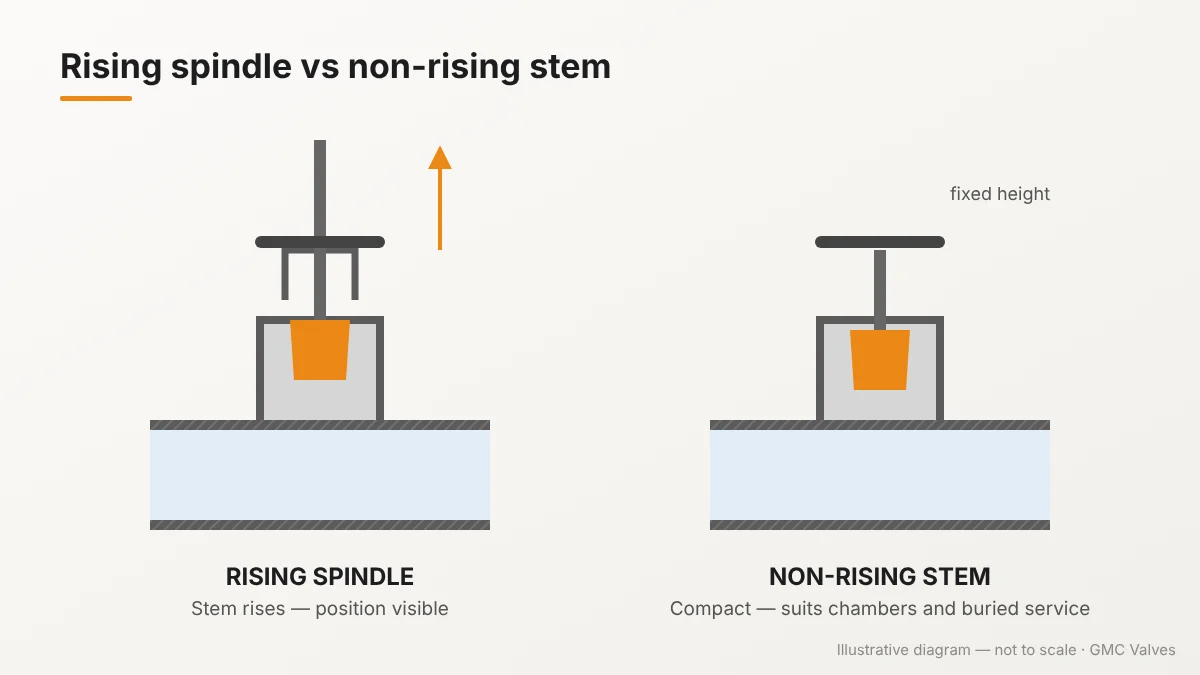
Most gate valves come in two stem designs: rising spindle (also called rising stem) and non-rising stem (NRS). Both move the same wedge to open and close the bore. The difference is how the stem turns that handwheel motion into lift — and that affects headroom, maintenance and how easy it is to see whether the valve is open.
Rising spindle gate valves
On a rising spindle valve, turning the handwheel drives the threaded stem up through a nut, lifting the gate. The stem therefore rises above the handwheel as the valve opens. In the common outside-screw-and-yoke (OS&Y) arrangement, the stem threads sit outside the body, clear of the fluid.
- Position at a glance: a long exposed stem means open; a short one means closed. This is why rising stem valves are widely used where valve position must be checked quickly, such as fire protection and plant rooms.
- Threads out of the fluid: when the threads are outside the body they are not exposed to the line fluid, which helps with dirty water, hot services and corrosive media, and they can be cleaned and lubricated.
- Needs headroom: allow space above the valve for the stem at full opening.
- Protect the exposed stem from paint, dust and impact so it keeps operating smoothly.
Non-rising stem gate valves
On an NRS valve the stem only rotates. Its threaded end screws into a nut in the gate, so the gate climbs up the stem inside the body while the handwheel stays at the same height.
- Compact and fixed height: useful in valve chambers, tight pipe racks and buried service, where the valve is often operated with a key through a surface box.
- No visual position indication unless an indicator is fitted — count turns or use an indicator where position matters.
- Threads are inside the body and in contact with the fluid, so this design is usually preferred for clean water services.
| Consideration | Rising spindle | Non-rising stem |
|---|---|---|
| Height when open | Increases by the stroke | Stays the same |
| Shows if open or closed | Yes, from stem position | Not without an indicator |
| Stem thread location | Outside the fluid (OS&Y designs) | Inside the body, in the fluid |
| Typical locations | Plant rooms, pump houses, fire lines, industrial process | Buried mains, valve chambers, limited headroom |
| Maintenance access to threads | Easy | Requires dismantling |
Which one should you specify?
Start with the installation: if there is limited height or the valve will be buried, a non-rising stem is usually the practical choice. If operators need to see valve position, the fluid is not clean water, or the valve is in an accessible plant room, a rising spindle valve is usually preferred. Project specifications and fire authority requirements may also dictate one type, so check them first.
GMC rising and non-rising stem valves
GMC's gate valve range includes both designs, for example the ductile iron PN-16 rising spindle gate valve and the ductile iron PN-16 non-rising stem gate valve. Use the comparison tool to see their dimensions side by side, then request a quote.
Frequently asked questions
Is a non-rising stem gate valve weaker than a rising one?
How can I tell if a non-rising stem valve is open?
Do rising spindle valves need more maintenance?
Products mentioned in this article

Gate Valve – Ductile Iron, PN-16, Rising Spindle
- Body
- Ductile Iron
- Rating
- PN-16
- Sizes
- Sizes DN50–DN700
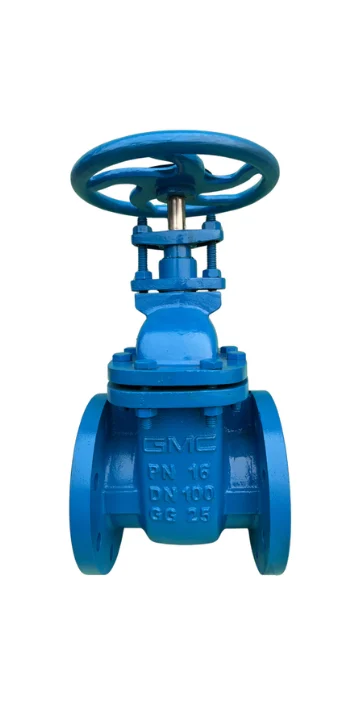
Gate Valve – Ductile Iron, PN-16, Non Rising Stem
- Body
- Ductile Iron
- Rating
- PN-16
- Sizes
- Sizes DN50–DN700

Gate Valve – Ductile Iron, Class 150, Non Rising Spindle
- Body
- Ductile Iron
- Rating
- Class 150
- Sizes
- Sizes DN50–DN800

Gate Valve – Carbon Steel, Class 300, Rising Spindle
- Body
- Carbon Steel
- Rating
- Class 300
- Sizes
- Sizes DN50–DN700